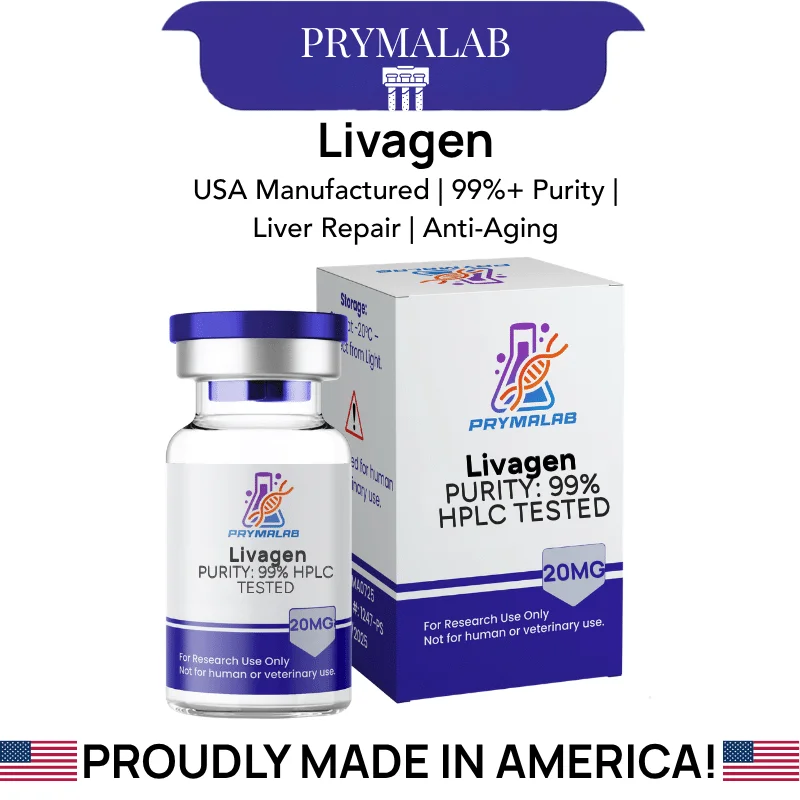
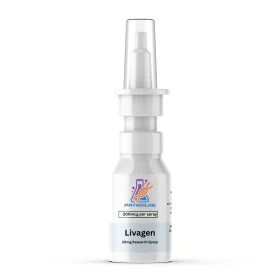
Livagen peptide is a lyophilized vial of the tetrapeptide Lys-Glu-Asp-Ala, written KEDA, the liver-directed compound in the Khavinson bioregulator range. It shares its first three residues with Vesugen and differs from Pancragen at a single position.
Specification Table
Livagen calculated chemical and handling data
| Property |
Value |
| Compound |
Livagen |
| Sequence designation |
KEDA |
| Amino acid sequence |
Lysine-Glutamate-Aspartate-Alanine |
| Residue count |
4 |
| Molecular weight, calculated |
461.5 g/mol, computed from standard residue masses plus water. Not a cited literature value; confirm against the lot certificate |
| Net charge at neutral pH |
Near neutral, one basic and two acidic residues |
| Oxidation-prone residues |
None |
| Chromophore |
None. Concentration cannot be determined by 280 nm absorbance |
| Compound class |
Short peptide bioregulator, cytogen subclass |
| Cytogen versus cytomax |
Cytogen. A laboratory-synthesised defined sequence, not a tissue extract |
| Source tissue of the parent fraction |
Liver tissue |
| Originating programme |
St Petersburg Institute of Bioregulation and Gerontology |
| Programme lead |
Vladimir Khavinson |
| Proposed mechanism in the literature |
Sequence-specific interaction with DNA, modulating tissue-associated gene expression |
| Mechanism status |
Hypothesis. Not independently established outside the originating programme |
| Receptor |
None identified |
| Appearance |
White lyophilized powder |
| Purity |
Per lot-specific certificate of analysis |
| Solubility |
Water soluble |
| Storage, lyophilized |
2-8°C or -20°C, protected from light and moisture |
| Regulatory status |
No approved human or veterinary formulation in any jurisdiction |
How Does Livagen Peptide Sit in the Family?
Livagen peptide sits in a range that shares a design logic that becomes visible once the sequences are lined up rather than read one at a time.
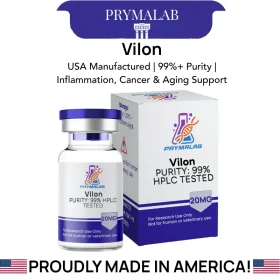
Vilon is Lys-Glu. Vesugen is Lys-Glu-Asp. Livagen is Lys-Glu-Asp-Ala. Pancragen is Lys-Glu-Asp-Trp. Four compounds, one shared opening, and a fourth position that changes the assigned tissue.
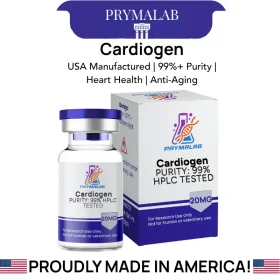
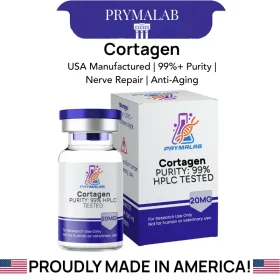
A parallel series starts from alanine. Cortagen is Ala-Glu-Asp-Pro, Cardiogen is Ala-Glu-Asp-Arg, and Epitalon is Ala-Glu-Asp-Gly. Same pattern, different first residue, and again the fourth position carries the tissue assignment.
Reading the family this way makes the underlying claim explicit: that a single terminal residue determines which organ a peptide addresses. That is a strong claim and it is testable.
What the published record does not contain is a systematic comparison across the series at matched molar concentrations in the same assay. Running one would either support the tissue-specificity idea or constrain it sharply.
The material cost of that experiment is negligible. Its absence after five decades is the single most surprising feature of this literature.
What Is a Liver Peptide Bioregulator?
The organ term draws more search volume than Livagen peptide does, and it describes the premise the whole programme rests on.
The St Petersburg group fractionated animal tissue extracts across several decades, working from the idea that an extract from a given organ contains short peptides carrying regulatory information specific to that tissue.
Livagen came from liver tissue in that fractionation, which is where the name comes from and why it is filed as a liver bioregulator rather than by sequence.
The class splits in two. Cytomaxes are peptide-containing tissue extracts and cannot be fully characterised analytically. Cytogens are laboratory-synthesised defined sequences that can be. Livagen is a cytogen.
That distinction is not cosmetic. Claims established for a cytomax do not transfer to the corresponding cytogen, because one is a mixture of unknown composition and the other is a single known molecule.
Anyone reading this literature should check which of the two a given paper used, because the terms are frequently interchanged in secondary sources.
What Livagen Peptide Benefits Have Been Measured?
The published endpoints are narrower than the search phrasing implies, and stating the gap is more useful than filling it.
Work from the originating programme reports hepatic tissue observations in aged rodent models, including histological assessment and markers of tissue-associated gene expression.
Cell-culture work in the family reports chromatin decondensation effects, which is the observation most often cited in support of the DNA-binding hypothesis. Fedoreyeva and colleagues published in that area.
No well-powered independent Western clinical trial exists for this compound or for any other in the family. That is the defining feature of the literature.
The measured endpoints are therefore tissue-level and gene-expression observations in models, reported by one programme. That supports a narrower claim than the phrasing suggests, and the narrower claim is still worth stating accurately.
How Does Livagen vs Ovagen Actually Compare?
Livagen peptide and Ovagen are both assigned to hepatic and gastrointestinal tissue, which makes the comparison a real question rather than a marketing one.
Livagen is Lys-Glu-Asp-Ala, a defined tetrapeptide with a sequence I could confirm against multiple independent descriptions.
Ovagen is assigned to liver and gastrointestinal tract in the same programme, but I could not confirm its sequence against a source I would rely on. Supplier listings repeat one another without citing a primary reference.
That asymmetry is the honest answer to the comparison question. One compound can be described precisely and the other cannot, at least not from the sources available publicly.
For a researcher choosing between them, that is a decisive practical difference, and a defined sequence can be verified on arrival by mass spectrometry. An undefined one cannot be verified against anything.
Asking a supplier for the Ovagen sequence on the lot certificate resolves it, and a supplier who cannot provide it is telling you something about their sourcing.
What Should a Livagen Certificate Show?
Livagen peptide at four residues is straightforward to characterise, so a thin certificate has nothing behind it.
Mass confirmation against roughly 461.5 for the free tetrapeptide. That figure is calculated from standard residue masses rather than quoted from a paper, so take it as the expected value and the certificate figure as the measurement.
Purity by reversed-phase chromatography. Short polar peptides retain poorly on standard gradients, so the method needs adapting and a supplier using a default peptide method may not be separating anything.
Counterion identity, stated alongside net peptide content. At 461.5 daltons a single trifluoroacetate at 114 is roughly 20 percent of the associated mass, which is a large correction.
Sequence stated explicitly as Lys-Glu-Asp-Ala. Livagen and Pancragen differ by one residue and about 100 daltons, which is obvious on a mass spectrum and invisible on a label.
Concentration cannot be checked by 280 nanometre absorbance, since this sequence has no aromatic residue. Amino acid analysis or a colorimetric assay is the dependable route.
How Should Buy Livagen Decisions Be Made?
For a compound this simple the supplier comparison reduces to a handful of answerable questions.
Measured mass rather than a catalogue figure, given how many compounds in this family sit within a hundred daltons of each other.
Counterion identity together with net peptide content, since the correction at this molecular weight runs to about a fifth of the weighed mass.
The chromatographic method used, since a default gradient does not retain a polar tetrapeptide well and a purity figure obtained that way measures very little.
Stereochemistry, or at minimum a statement of which enantiomers were used, because L and D variants share a mass and differ in everything else.
Price differences in this family are large and they track documentation more closely than they track anything else.
What Does Livagen Peptide Research Need to Control For?
With no receptor and an unresolved mechanism, the controls carry the weight that binding data would normally carry.
A scrambled-sequence arm is the primary specificity test. For a tetrapeptide there are twenty-three alternative orderings, so one scrambled control tests a single alternative rather than the whole space, which is worth stating rather than glossing.
Free amino acid arms distinguish an effect of intact Livagen peptide from an effect of lysine, glutamate, aspartate and alanine separately after hydrolysis. At matched molar concentrations those arms separate the possibilities directly.
A neighbouring-sequence arm is the control this family makes uniquely available. Running Vesugen, which is the same sequence minus the terminal alanine, tests whether that single residue does what the organ naming implies.
Nobody appears to have published that comparison, and it is both cheap and decisive.
On the DNA-binding proposal, measure rather than infer. Calorimetry, surface plasmon resonance against immobilised oligonucleotides and mobility shift assays all read binding directly instead of working backwards from an expression change.
How Should the Vial Be Handled?
Livagen peptide is among the more forgiving compounds in this catalogue and the handling notes are short.
No cysteine, no methionine, no tryptophan and no asparagine-glycine motif. The routes that degrade most peptides are all unavailable, which is true of every bioregulator here except Pancragen.
Hold lyophilized material sealed against light and moisture at 2 to 8 degrees Celsius or colder. Refrigeration is sufficient for a compound this stable.
Water solubility is good. Add diluent slowly down the vial wall and swirl rather than shaking. Material that resists dissolving is worth questioning rather than agitating harder.
Reconstituted solution at 2 to 8 degrees, aliquoted before freezing, though freeze-thaw tolerance here is better than for almost anything else in the catalogue.
Record lot, counterion, net peptide content, diluent, volume, concentration and date.
A closing note on what would move this literature forward. The family structure hands researchers an unusually clean experimental design and nobody appears to have run it.
Four compounds sharing Lys-Glu-Asp with different terminal residues, tested side by side at matched molar concentrations in one assay on one day, would either support tissue specificity or refute it in a single experiment.
The material cost is trivial and the compounds are chemically stable enough that the logistics are simple. Its absence after five decades of publication is the most surprising feature of this whole area.
Someone will run it eventually, and whoever does will have answered the central question the programme has been asserting rather than testing.
Published Literature
References verified against the publisher record. This literature originates almost entirely from one research programme, which bears directly on how it should be weighted.
- Khavinson VK, Malinin VV. Gerontological Aspects of Genome Peptide Regulation. Karger, Basel; 2005.
- Khavinson VK. Neuroendocrinology Letters. 2002;23(Suppl 3):11-144.
- Anisimov VN, Khavinson VK. Critical Reviews in Oncology/Hematology. 2010;74(1):46-66.
- Fedoreyeva LI, Kireev II, Khavinson VK, Vanyushin BF. Biochemistry (Moscow). 2011;76(11):1210-1219.
- Khavinson VK, Solovyov AY, Zhilinsky DV, Shataeva LK, Bandaletova TY. Bulletin of Experimental Biology and Medicine. 2012;153(4):500-505.
Frequently Asked Questions
What is Livagen peptide?
A lyophilized vial of the tetrapeptide Lys-Glu-Asp-Ala, written KEDA, the liver-directed compound in the Khavinson bioregulator range. Supplied for laboratory research alone. No approved formulation exists in any jurisdiction.
How does it relate to the other bioregulators?
It shares its first three residues with Vesugen and differs from Pancragen only at the fourth position. Vilon, Vesugen, Livagen and Pancragen form a series with one shared opening and a fourth residue carrying the tissue assignment.
What does that pattern imply?
That a single terminal residue determines which organ a peptide addresses. It is a strong claim, it is testable, and no systematic comparison across the series at matched molar concentrations appears in the published record.
What is a liver peptide bioregulator?
A term describing the programme premise rather than a pharmacological class. Livagen came from liver tissue during fractionation, which is why it is named and filed by organ rather than by sequence.
Does cytomax literature apply to Livagen?
No. Cytomaxes are tissue extracts of unknown composition and cytogens are defined synthetic sequences. Claims established for one do not transfer to the other, and secondary sources frequently interchange the terms.
What endpoints have been measured?
Hepatic tissue observations in aged rodent models including histology and gene-expression markers, plus cell-culture work reporting chromatin decondensation, which is the observation most cited in support of the DNA-binding hypothesis.
How does Livagen compare with Ovagen?
Livagen has a sequence I could confirm across independent descriptions. Ovagen does not, at least not from publicly available sources. That asymmetry is the honest answer, and it is a decisive practical difference.
Why does that difference matter?
Because a defined sequence can be verified on arrival by mass spectrometry and an undefined one cannot be verified against anything. Asking a supplier for the Ovagen sequence on the lot certificate resolves it.
What mass should the certificate show?
Roughly 461.5 for the free tetrapeptide, calculated from standard residue masses rather than quoted from a paper. Take that as the expected value and read the certificate figure as the measurement.
How large is the counterion correction?
At 461.5 daltons a single trifluoroacetate at 114 is roughly 20 percent of the associated mass. Net peptide content on the certificate is the figure to calculate from rather than the vial label.
Can concentration be checked by absorbance?
No. The sequence contains no aromatic residue, so there is nothing absorbing at 280 nanometres. Amino acid analysis or a colorimetric protein assay is the dependable route, which is true of every bioregulator here except Pancragen.
Compliance Statement
Livagen peptide is sold exclusively for laboratory research use. It is not a drug, food, or cosmetic product, and it is not a dietary product of any kind. It is not approved by the FDA or any comparable authority for human or veterinary use, its proposed mechanism has not been independently established, and amounts cited are figures from published studies in the species those studies used. This product is not intended to diagnose, treat, cure, or prevent any disease. It must not be given to humans or animals. Purchase is restricted to qualified researchers and institutions operating within applicable laws. All handling is the responsibility of the purchasing laboratory.














19 reviews for Livagen Peptide 20mg